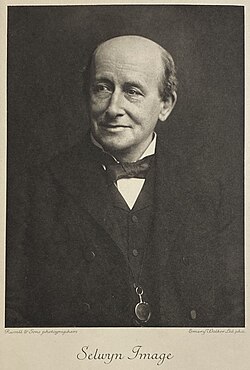
 Selwyn Image (February 17, 1849 - August 21, 1930) was an English artist, designer, poet, and scholar who played a pivotal role in the British Arts and Crafts Movement
and late Victorian Aestheticism.
Selwyn Image (February 17, 1849 - August 21, 1930) was an English artist, designer, poet, and scholar who played a pivotal role in the British Arts and Crafts Movement
and late Victorian Aestheticism.Queer Places:
Marlborough College, Bath Rd, Marlborough SN8 1PA, United Kingdom
University of Oxford, Oxford, Oxfordshire OX1 3PA
20 Fitzroy St, London W1T 5HP, UK
Highgate Cemetery East, Swain, Highgate, London Borough of Camden, Greater London N6 6PJ England
Selwyn Image (February 17, 1849 - August 21, 1930) was an English artist, designer, poet, and scholar who played a pivotal role in the British Arts and Crafts Movement
and late Victorian Aestheticism.
Born in Bodiam, Sussex, to the Rev. John Image, Selwyn initially set out to follow his father into the Church of England. He attended Marlborough College and then New College, Oxford, graduating in 1872. At Oxford, he studied drawing directly under John Ruskin, the university’s first Slade Professor of Fine Art. Ruskin’s philosophy—connecting artistic integrity, handcraftsmanship, and moral purpose—profoundly shaped Image’s worldview.
Image was ordained an Anglican deacon in 1872 and a priest in 1873, serving as curate in Tottenham and at St. Anne's, Soho. However, the pull of the artistic life and his growing frustration with rigid Victorian dogma led him to formally abandon the priesthood in 1882.
Upon leaving the church, Image dedicated himself fully to visual and graphic arts. In 1883, alongside architect Arthur Heygate Mackmurdo and designer Herbert Percy Horne, he co-founded the Century Guild of Artists. The Guild sought to elevate craft to the status of fine art, producing integrated designs for furniture, wallpapers, stained glass, metalwork, and fine printing.
Image designed the iconic, sinuous cover for The Century Guild Hobby Horse (1884–1894), widely regarded as one of the earliest precursors to Art Nouveau graphic design.
He became a premier stained-glass designer, known for combining botanical observation with strong lead line geometry.
In 1896, he collaborated with early music pioneer Arnold Dolmetsch, hand-painting decorative motifs across Dolmetsch’s first restored harpsichords and clavichords.
Later in life, Image became an elder statesman of British art, serving as Master of the Art Workers' Guild in 1900 and holding the prestigious post of Slade Professor of Fine Art at Oxford from 1910 to 1916. At age 42, he began a relationship with Janet McHale, a music hall dancer, whom he later married. He died in London on August 21, 1930.
In 1889, Mackmurdo, Horne, and Image established the headquarters and shared studio space of the Century Guild at 20 Fitzroy Street in London’s Bloomsbury/Fitzrovia district. The multi-story townhouse quickly grew into one of the most famous aesthetic and bohemian salons of the 1890s.
20 Fitzroy Street served as a sanctuary where the boundaries of Victorian propriety were pushed. The house was closely tied to late 19th-century homophile and "Uranian" subcultures:
The tragic Aesthetic poet and devout Catholic Lionel Johnson lived at 20 Fitzroy Street from 1890 until 1895. Johnson was a central figure in the queer literary networks of the decade and a close companion of both Oscar Wilde and Lord Alfred Douglas (it was Johnson who originally introduced Douglas to Wilde in 1891).
Herbert Percy Horne—co-tenant of Fitzroy Street, co-editor of The Hobby Horse, and eventual art historian—lived a notoriously untraditional lifestyle, maintaining intimate relationships within both bisexual aesthetic circles and Italian art networks.
The group’s periodical, The Century Guild Hobby Horse, edited out of 20 Fitzroy Street, was notable for publishing literature that subtly or openly explored same-sex desire. Most famously, in the October 1890 issue, Lionel Johnson published his poem "A Dream of Youth", a vividly sensual, homoerotic work celebrating the idealization of male beauty. Though it caused scandal and was censored in later republications, Image and his co-editors provided a platform for such expressions when few existed.
Although Selwyn Image himself maintained relationships with women, he was remarkably progressive for an ex-clergyman of his era. He explicitly campaigned against moral puritanism in the Church and Victorian society.
Image openly defended social groups that were marginalized or criminalized at the time, offering social and intellectual backing to prostitutes, music hall performers, and homosexuals who frequented his Fitzroy Street salon.
Beyond literary radicalism, 20 Fitzroy Street hosted the Rhymers' Club—where poets like W.B. Yeats, Ernest Dowson, and Arthur Symons met to read verse—and musical evenings where Arnold Dolmetsch gave intimate clavichord recitals.
The atmosphere at 20 Fitzroy Street provided a vital link bridging the Arts & Crafts Movement, the Decadent Movement, and the early modern LGBTQ subcultures of fin-de-siècle London.
References:
Support this project
This website is a passion project researched, developed, and funded entirely by me. If you find the content valuable and would like to help support the ongoing research and hosting costs, any contribution is deeply appreciated.
Thank you for keeping this independent resource alive!
My books on Amazon: Elisa Rolle's books